Galaxy Simulations
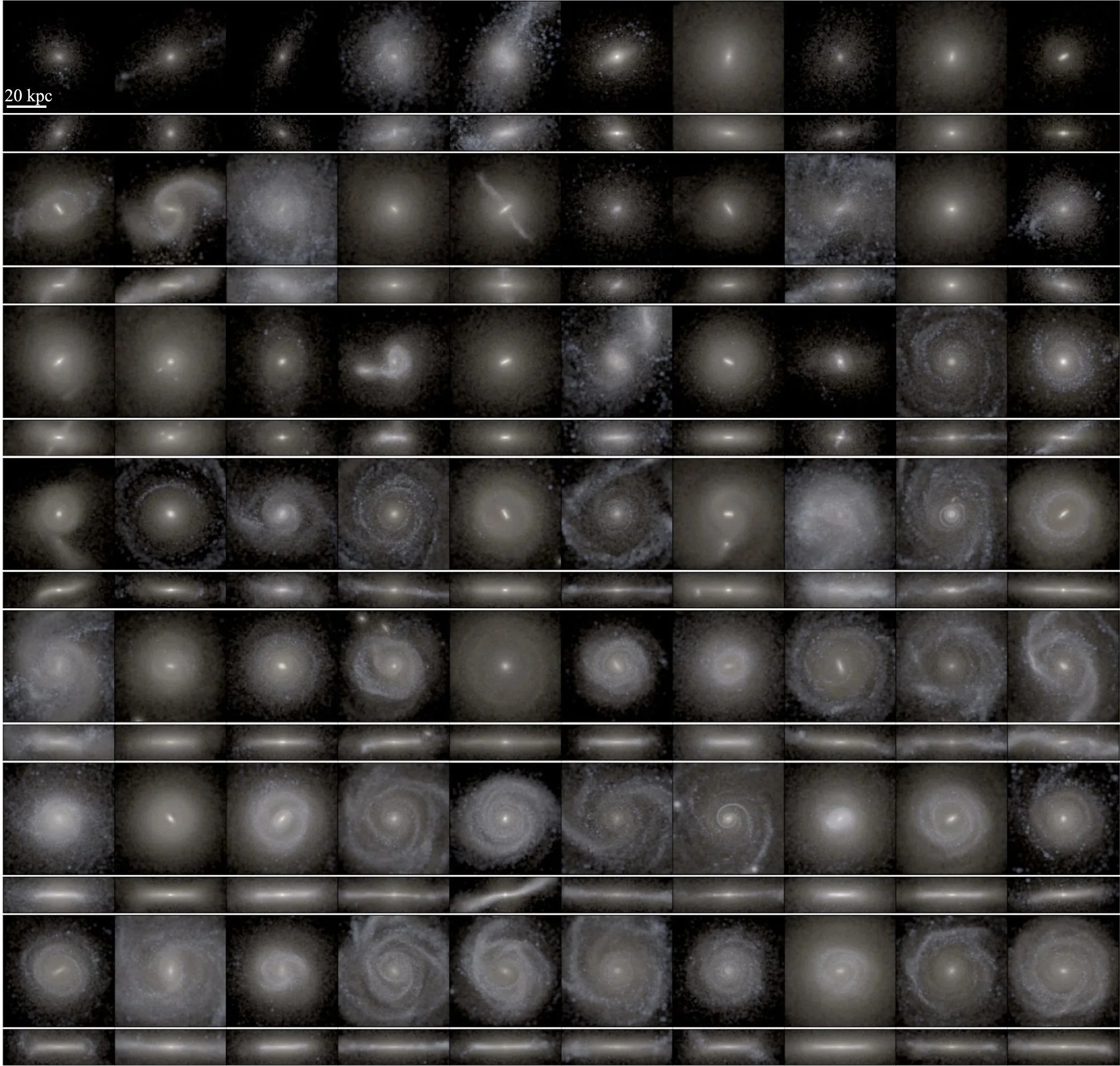
Visible galaxies form at the centers of vast dark matter halos, and their properties are sensitive to features of these halos. For example, the density distribution of a halo, including its smaller-scale substructure, can leave observable footprints through its gravitational impact on the visible matter. Our group studies how variations in the dark matter model can affect galaxy formation and evolution and develops the numerical simulations needed to accurately model these effects for current and upcoming astrophysical observatories, including the Rubin Observatory, Nancy Grace Roman Telescope, JWST, and Euclid. Our recent work focuses on Cold Dark Matter, as well as models where the dark matter can interact with itself, either elastically or inelastically.
For some images and movies based on our simulations, see:
Cold and Warm Dark Matter: The DREAMS Project
Elastic Self-Interacting Dark Matter: Hainje et al.
Inelastic Self-Interacting Dark Matter: Roy et al. and Mandacarú Guerra et al.